Public Hearing on Bokeelia on Wednesday, March 11
Residents opposed to the proposed location for a new 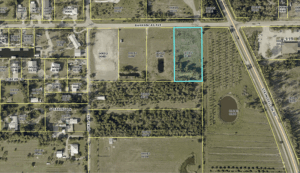 cell phone tower at the corner of Stringfellow and Barrancas roads — on the west side across from the Bokeelia Post Office — have the opportunity THIS WEDNESDAY to argue against the tower before the Lee County Hearing Examiner.
This Wednesday, March 11, the Lee County Hearing Examiner will hold a public hearing for a special exception (SEZ2025-00011) and zoning variances (VAR2025-00006) requested for the project called the “Bokeelia Tower.”
Skyway Towers, LLC, from Tampa, Florida, is requesting the exception and variances in order to build a 150-foot tall tower at 7645 Barrancas Ave., that would include a communications tower with antenna, a fenced compound with ground equipment and easement for access to the tower compound. The site, near the Barrancas Post Office, is currently vacant and zoned AG-2.
- Lee County staff has recommended approval — which we disagree with. You can read the staff determination letter here
In August 2025, more than 100 people attended the public information session that the GPICA hosted with representatives from the Project. Attendees — and the GPICA — overwhelmingly support additional cell phone towers to improve coverage on the island. However, meeting attendees were strongly opposed to this location for a cell phone tower. (Read the letter we sent to the County here.)
If You Go
Please attend the Hearing Examiner meeting to oppose this project based on its incompatibility with current Pine Island and Lee County zoning regulations. We’re hoping to show overwhelming public opposition to this tower location.
- What: Public hearing for zoning change request for cell phone tower in Bokeelia
- When: 9 a.m., Wednesday, March 11
- Where: 1500 Monroe St., Fort Myers. (Second-floor HEX room of the public works building.)
Tips for Attending & Speaking During the Hearing
- To get to the hearing and not be rushed, you probably need to leave Pine Island around 7:30 a.m.
- Be sure to pay for enough parking time so you don’t get a parking ticket.
- Click here and choose “Downtown Fort Myers” to view parking locations. To pay online, visit www.premiumparking.com and type in Fort Myers to look for the lot you are parked in. Note: If you do an online search, be sure to avoid the “sponsored” websites. Some are reportedly fraudulant.
- We encourage you to speak during the meeting. You will need to fill out a speaking card prior to the hearing that includes your name, address and key points that you plan to make.
- If you arrive late, there is a short hall down the side of the meeting room where you can enter the seating area without interrupting the proceedings.
- Remarks and comments made before the Lee County Hearing Examiner during this quasi-judicial proceeding must be focused on Lee County zoning rules and regulations, not emotional arguments. To that end, we’ve developed some notes about why these variances are incompatible with Pine Island zoning regulations. Please feel free to use them in your own remarks.
Adverse Impact on Property Values and Neighborhood Character
This Project is inconsistent with the neighborhood character and scale and, for a number of residents, the Project is within line-of-site; for others, it’s literally right next-door.
- Realtors and peer-reviewed studies report that cell towers can reduce home property values by up to 20 percent. (Details here)
- An overwhelming 94 percent of home buyers and renters surveyed by the National Institute for Science, Law & Public Policy (NISLAPP) say they are less interested and would pay less for a property located near a cell tower or antenna. (Details here)
- A more recent 2024 study published in the peer-reviewed academic journal, International Journal of Housing Markets and Analysis, on cell towers and property value found “a significant impact” of proximity to cell phone tower base stations on residential property sale prices. The closer to the cell tower is to a residential property, the higher the impact on the residential property sale price. (Details here)
Anecdotally, we’ve heard from many local residents already living in the area that they believe this Project is an eyesore at the entrance to Bokeelia. We believe potential buyers would feel the same way, thus saddling nearby residents with hundreds of thousands of dollars in lost property values.
Site Location, Selection and Available Location Alternatives
By mandate, for approval, a variance requires that the Applicant is experiencing “unnecessary hardship.” In this case, the owners say the hardship is the small size of the property. However:
- Unique Hardship Required: Under the Lee County Land Development Code (LDC), a variance requires showing that exceptional circumstances inherent to the land (e.g., unusual shape, topography) create an undue burden. The claimed hardship arises solely from the applicant’s decision to construct a 150-foot monopole and associated compound that cannot fit within required setbacks.This is not a hardship imposed by the land. It is a hardship created by the applicant’s chosen design.
- Not Just Convenience: The availability of suitable, alternative locations nearby suggests the applicant can comply with regulations elsewhere, meaning the current site does not have a “unique” hardship.
- Minimal Relief: Only the minimum variance needed to alleviate the hardship can be granted. If the project can fit on another lot, the variance is not the minimum relief.
- Negative Impact: A variance must not be detrimental to the surrounding area or neighborhood character. (See previous section)
We know that there are a significant number of unimproved lots on the east side of Stringfellow Road better suited for this project that are:
- Larger and would not require a variance;
- Do not have nearby or line-of-sight residents or would not cause property value loss to other owners;
- Could co-exist on a another nearby with an existing cell phone structure.
Approval Will Set a Bad Precedent
The hearing examiner may deny variances or zoning changes that set a “bad precedent” to prevent undermining the integrity of the Comprehensive Plan and Land Development Code (LDC). Approving this project would create “spot zoning,” leading to chaotic development, reduced property values, and a deluge of similar requests.
- Undermining the Comprehensive Plan: A variance cannot be granted if it is detrimental to the neighborhood, as it sets a precedent that encourages future developers to ignore established rules.
- Preventing “Spot Zoning”: Approving a request that deviates from the plan often results in arbitrary and discriminatory selection (spot zoning), which is legally vulnerable.
- “Dangerous Precedent”: Allowing individual convenience to override zoning regulations sets a dangerous precedent that can stifle ordered growth.
- Preserving Community Character: The examiner may deny a request in order to protect the established character of an area, ensuring that one exception does not trigger a cascade of similar developments.
Residents of Pine Island were extremely involved in the development of the Lee County Comprehensive Plan, especially the Pine Island Overlay, which dictates specific locations for commercial property. The location of this property is well outside that zone, outside of the neighborhood’s character and the Project’s approval would set a bad precedent leading to the watering down of well-considered zoning rules.
Health Concerns from Microwave Emissions
The Lee County Hearing Examiner can and must deny zoning variance requests that could harm the health, safety and welfare of nearby residents. Variances are only granted if they are not detrimental to the neighborhood or public welfare, and they must not create an undue burden on neighbors.
- While the Applicant stated that Federal government studies indicate no health concerns, the issue is not so cut-and-dry.
- While major health authorities have concluded that current evidence does not establish a causal link between typical environmental exposure levels from cell towers and adverse health outcomes, the research is not yet conclusive and is ongoing, particularly in the area of long-term, low-level exposure.
- That the topic is still being debated and discussed within the scientific community indicates that the question is not yet settled and we would urge the Hearing Examiner to err on the side of protecting public health.